
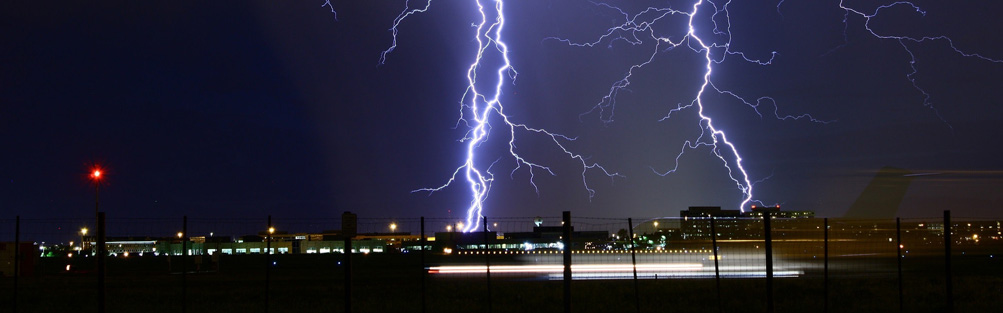
To know what lightning protection systems are available in the security industry, we must first understand the development and changes of the security industry. From the emphasis on "no AI, no security" in 2018 to a focus on implementation in 2019, we have noticed that not only is artificial intelligence entering the security industry, but security companies are also radiating to other markets with their unique expertise.
When it comes to grounding for security monitoring systems, there are generally three considerations: safety, anti-interference, and lightning protection. There are many measures related to lightning protection in the security industry, but some concepts are not accurate or even incorrect, making it difficult to choose when referencing them for engineering design.
(1) Protection against direct lightning strikes. The outdoor cameras and poles of security systems should be placed within the effective protection range of a separate lightning rod and as far away from it as possible. The cameras should not be installed on the lightning rod, the pole of the camera should not be designed as a lightning rod, the camera should be insulated from the pole, and never grounded.
(2) The front-end camera of a security lightning protection system must be insulated from the ground. Lightning arresters should be used to prevent induced lightning, but some lightning arresters have a grounding point. However, the front-end video signal ground (camera casing, BNC casing, video wire shield) cannot be grounded. The video signal ground must always be insulated from the ground. However, there may still be problems with "transient multi-point grounding" to consider.
(3) Whether considering lightning protection, anti-interference, or anti-static measures, front-end systems of security systems should never be directly grounded; that is, there should be no "ground loop" in the system. The grounding design principle for security systems is "single-point grounding": the mainframe of the system should be grounded, which is not only secure grounding but also used to discharge static electricity from the system.
(4) Cameras of the system must also be insulated from steel-structured buildings, metal ceilings, wire troughs, elevator cars, and other metal surfaces.
The lightning protection systems used in the security industry are closely related to industry trends, which currently include smart transportation, smart access control, smart elderly care, and public security big data, to name a few. For example, the Ministry of Communications plans to invest 2.7 trillion yuan in the construction of intelligent transportation systems.
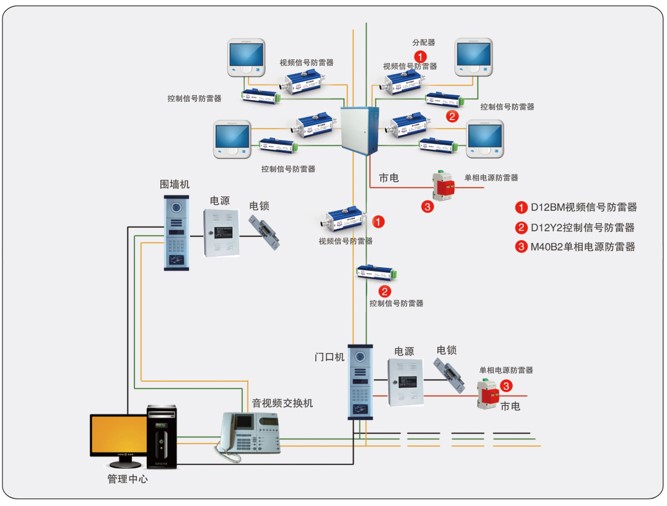
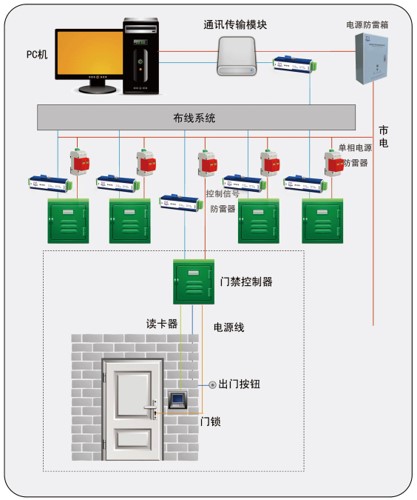
Overall, security lightning protection systems include parking lot lightning protection, visual intercom lightning protection, perimeter alarm lightning protection, access control lightning protection, background music lightning protection, smart transportation lightning protection, security monitoring lightning protection, and more.
As a lightning protection solution service provider, Shenzhen Tiandun provides a range of services, including lightning protection scheme design, lightning arrester supply and installation testing, and customized solutions based on customer needs. Please feel free to contact us for further information.
 Do surge protectors work against lightning?April 27, 2025Although surge protectors cannot directly prevent lightning strikes, they can significantly reduce the damage caused by lightning strikes to electrical equipment and circuits. As a specially designed ...viewDetailed Explanation of Tiered Surge Protection for Distribution BoxesAugust 11, 2025In lightning protection, the surge protection device in distribution boxes plays a crucial role. According to the principle of graded lightning protection, and based on the likelihood of a building be...viewWhat Are the Lightning Protection Devices?September 18, 2021The whole set of lightning protection devices can be divided into flash catcher, lead wire, lightning protection and grounding device. Lightning protection device is to prevent the equipment from bein...viewTechwin Supports Nanchang Metro: Safeguarding Urban Traffic SafetyOctober 10, 2025At 10:18 AM on June 28, initial operations simultaneously commenced for three extended lines of Nanchang Metro: the north extension and east extension of Line 1, and the east extension of Line 2. The ...viewHow to Select a Proper Surge Protector?December 8, 2021Surge Protective Device is a device designed to protect against transient overvoltages, serving as an important component of the internal lightning protection system. According to its specific usage, ...viewHow to Select Lightning-Proof Surge Protectors for Buildings?March 18, 2025In the lightning protection of a building's power supply, a lightning-proof surge protector safeguards equipment by discharging lightning currents and limiting surge voltages. It is the main means...view
 EN
EN
 jp
jp  ko
ko  fr
fr  de
de  es
es  it
it  ru
ru  pt
pt  ar
ar  vi
vi  th
th  ro
ro  bg
bg  nl
nl