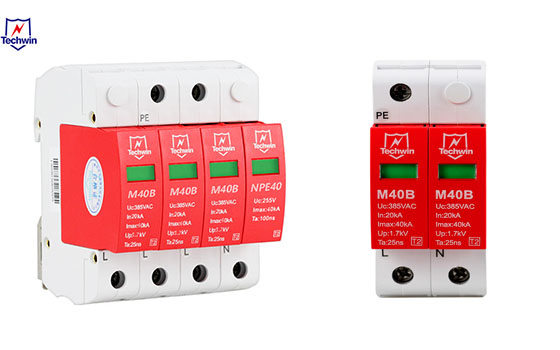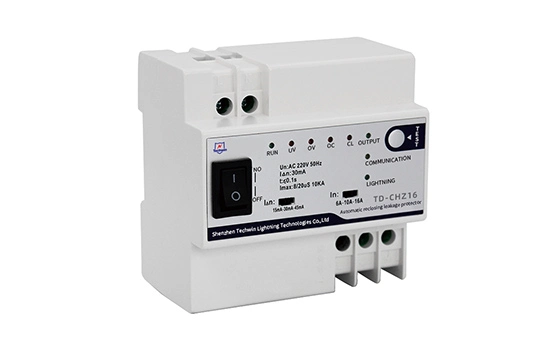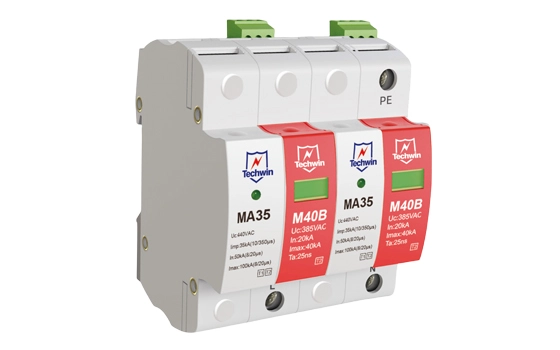

In the lightning protection of a building's power supply, a lightning-proof surge protector safeguards equipment by discharging lightning currents and limiting surge voltages. It is the main means of lightning protection for electronic equipment and an essential part of internal lightning protection. Correct selection and installation of lightning-proof surge protectors can effectively ensure the safety of electrical equipment within buildings. This article will detail the methods for selecting lightning-proof surge protectors.
A surge protector tested for Class I or Class II should be installed at the main distribution box where the AC power line enters the building, at the intersection of the lightning protection zones LPZ0A or LPZ0B and LPZ1, to serve as primary protection.
In the subsequent protection zones at the distribution sub-distribution box, electronic equipment room distribution box, etc., a Class II or Class III surge protector should be chosen for installation based on the equipment's needs as secondary protection. For particularly important electronic information equipment power ports, a Class II or Class III surge protector can be added as fine protection. For information equipment using DC power, choose a compatible DC power surge protector according to its operating voltage requirements.
The number of levels of lightning proof surge protector should comprehensively consider the following factors:
Protection distance
Length of connecting wires for the lightning-proof surge protector
Impulse voltage rating (UW) of the protected equipment
Each level of surge protector should withstand the expected discharge current at the installation point, and its effective protection level (UP/F) should be less than the UW of the corresponding equipment.
When the line length between a voltage-switching type surge protector and a voltage-limiting type surge protector is less than 10 meters, or the line length between voltage-limiting type surge protectors is less than 5 meters, a decoupling device should be installed between the two levels of surge protectors. If the surge protector has an automatic energy coordination function, the line length is not limited.
The connecting wires of a lightning-proof surge protector should be short and straight, with a total length not exceeding 0.5 meters.
When the line length between the primary spd power supply at the entrance and the protected equipment is greater than 10 meters, an additional surge protector should be installed at the sub-distribution box or protected equipment location.
Proper selection of lightning-proof surge protectors requires comprehensive consideration based on the building's lightning risk assessment results, lightning protection zone division, and equipment needs. Reasonably configuring and installing surge protectors can not only extend the service life of the equipment but also ensure the safe operation of the building's electrical system.
 Protecting Your Business Investments: The Role of Power Surge MonitoringSeptember 11, 2023In today's business landscape, where technology plays a central role in operations, safeguarding your electronic assets is paramount. Power surges, those sudden, unpredictable spikes in electrical...viewThe Surge Protector Will Be Effective 100%?November 28, 2023No surge protector can provide 100% protection against all possible electrical surges or power-related issues. Surge protectors are designed to limit the voltage supplied to an electrical device by ei...viewHow to install a SPD?August 11, 2023Techwin surge protective devices (SPDs) are designed to protect electrical equipment from power surges. Installing an SPD is essential to ensuring the safety and longevity of your devices. Here is a s...viewBudgeting for Stability: The Cost-Effective Approach to SPD for Power SupplyJanuary 5, 2024In the intricate landscape of power management, Surge Protection Devices (SPDs) for power supply stand out as cost-effective guardians, ensuring stability without breaking the budget. This passage del...viewBenefits of Using Signal Surge ProtectorsFebruary 29, 2024In today's fast-paced world, we rely heavily on technology to stay connected, informed, and productive. From smartphones to laptops to smart TVs, we are constantly surrounded by electronic devices...viewWhat Are the Classification Protection of Lightning Protection System?January 10, 20221. Type 1 lightning protectionThe aim is to prevent voltage surge from being directly conducted from LPZ0 to LPZ1 and limit the voltage surge varying from tens of thousands of volts to hundreds of tho...view
 EN
EN
 jp
jp  ko
ko  fr
fr  de
de  es
es  it
it  ru
ru  pt
pt  ar
ar  vi
vi  th
th  ro
ro  bg
bg  nl
nl