
This article will introduce the importance and working principle of surge protector for CCTV that meet the high availability requirements of closed-circuit television systems.
A closed-circuit television system consists of at least one camera, a monitor, and an appropriate video transmission path. Remote camera stations are usually equipped with pan/tilt heads, allowing operators to individually adjust the position and angle of the camera station. In the simplest case, the transmission line between the junction box and the monitor is a coaxial cable or a balanced two-wire cable. Coaxial cable is used for unbalanced transmission, meaning the video signal is transmitted through the core (inner conductor) of the coaxial cable. The shield (ground) is the reference point for signal transmission. Balanced transmission (balun) for two-wire cable is used to convert the coaxial signal to a two-wire signal.
Power supply cables are usually wired separately. However, for IP cameras, a single cable is used to transmit both video signals and power. RS485 bus controls the pan and tilt of the camera. Cameras, alarms, access control panels, and DVRs in a CCTV system are easily damaged by surges caused by lightning strikes. In order to prevent the failure of camera and monitoring systems, components must be protected from atmospheric discharges and surge voltages.
Surge protector for CCTV provide protection by effectively diverting excessive voltages away from the device. One of the main advantages of surge protectors used for safety systems is their ability to ensure continuous operation and avoid downtime. CCTV camera systems are often installed outside buildings or on objects, and are therefore subject to external and potentially destructive influences, such as thunderstorms. During a thunderstorm, equipment can be completely destroyed by a direct lightning strike, or damaged by a remote lightning strike if surge voltages are induced in the transmission cables during the release of electromagnetic waves.
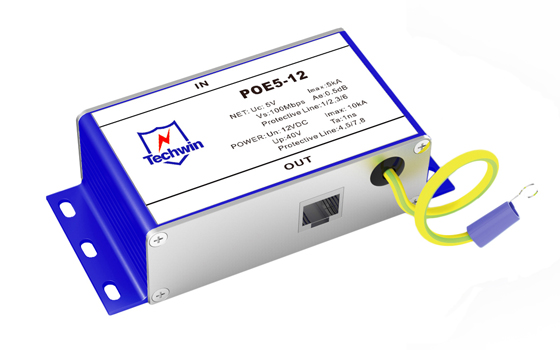
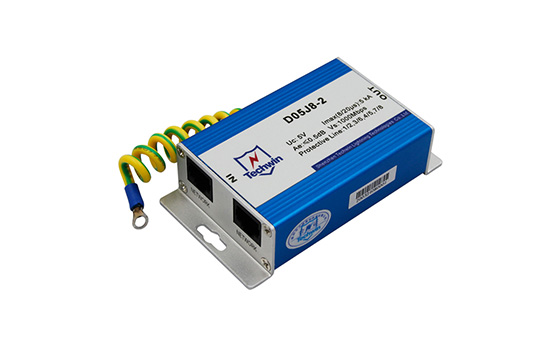
The structure of camera systems varies. For video transmission, coaxial cables with BNC plug connections are often used as the cable medium, or twisted pair cables are used. If the camera also has a control unit, the transmission is usually controlled via the serial RS485 interface through a twisted pair cable. Two-pole cables are used as the power supply. Modern cameras (i.e., so-called IP cameras) have a single RJ45 connection that can transmit data and video signals and is powered via Power over Ethernet (PoE). Signal lightning protection, such as network lightning protectors, need to be installed at the entry point.
Power over Ethernet (PoE) switches and surge protector for CCTV add an extra layer of protection for PoE security cameras against damage from lightning strikes. PoE switches send power and data to PoE security cameras via a single Ethernet cable. They can also act as buffers and provide a stable power source to help protect cameras from surges. Some PoE switches have built-in surge protection, which helps mitigate lightning damage in two main ways:
Power Surge Protection
PoE switches with power surge protection prevent voltage spikes from reaching and damaging cameras.
Buffering Effect
PoE switches can act as buffers between different cameras, reducing the spread of overvoltage from one camera cable to another.
Surge protector for CCTV help protect electronic devices from power outlet surges by preventing voltage spikes from spreading to any connected electronic device. Surge protectors connect to power outlets, and security cameras can connect to the surge protector using a separate power adapter. They are particularly useful in areas prone to thunderstorms.
It’s important to know that surge protectors and PoE switches cannot provide 100% protection for security cameras from lightning damage, but they do reduce the overall risk of damage to the entire security system. It is also important to use reputable brands and check that the surge protectors provide sufficient overvoltage protection (measured in joules) to protect any connected electronic equipment.
 The Difference of Voltage Switching SPD and Voltage Limiting SPDFebruary 17, 2023Voltage switching SPDs are designed to switch between two states, an "off" state and an "on" state, based on the voltage level. When the voltage level is below a certain threshold,...viewSurge Protector Grading Protection-Do You Know It?March 13, 2023The surge current energy generated by lightning strikes is enormous, so a step-by-step release approach should be adopted to release the surge current into the ground in stages.1. Graded Protection of...viewDebunking Common Myths and Misconceptions about Lightning Protection DevicesFebruary 29, 2024In today's fast-paced world, technology plays a crucial role in our everyday lives. From smartphones to smart homes, we rely on various electronic devices to stay connected and entertained. Howeve...viewWhat Are the Experimental Requirements for the Leakage Current of the Surge Protector?August 10, 20221. The value of surge protector discharge current protection equipmentIn addition to the discharge current, the lightning protection capability also depends on the test waveform. The outdoor incoming ...viewWhat Is a Transient Voltage Surge Suppressor (TVSS)?June 26, 2024Transient Voltage Surge Suppressor (TVSS) is a device used to protect electronic equipment from transient overvoltage, spikes, or surges. With the increasing reliance on network infrastructure due to ...viewPrinciples and Performance Parameters Determination, as well as Installation Regulations of Surge ProtectorsMarch 13, 2023Surge protection device, also known as SPD, is an electronic device that offers safe protection for various electronic equipment, instruments, and communication lines. It is used to limit transient ov...view
 EN
EN
 jp
jp  ko
ko  fr
fr  de
de  es
es  it
it  ru
ru  pt
pt  ar
ar  vi
vi  th
th  ro
ro  bg
bg  nl
nl