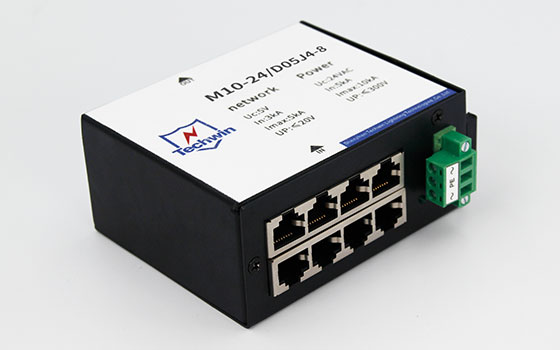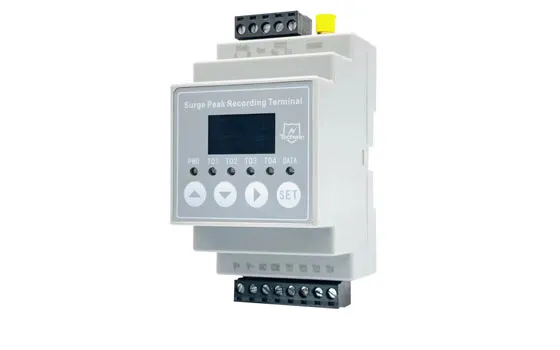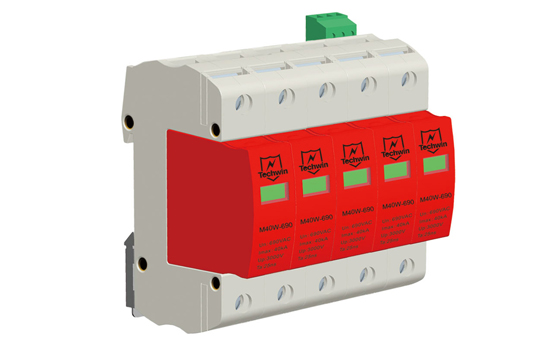


Surge Protective Device (SPD) is a device used to protect electronic equipment from power surges or transient voltages. They are connected in parallel with the load power circuit that needs protection and can also be used in power supply networks at all levels. This article will delve into the working principle of surge protective devices and their important role in electrical systems.
Surge protective devices control transient voltages by diverting or limiting surge currents, protecting sensitive electronic equipment connected to them, such as computers, televisions, washing machines, and safety circuits (such as fire detection systems and emergency lighting). These devices contain sensitive electronic circuits that are prone to damage from transient overvoltages; thus, surge protective devices play a crucial role in protecting electrical installation systems.
The primary function of the surge protective device (SPD) is to protect electrical systems and equipment from surge events by limiting transient voltages and diverting surge currents. Surges can come from external sources, the most intense usually being lightning; they can also come from internal electrical load switching. These internal surges (accounting for 65% of all transients) include sources such as load turning on and off, relay and circuit breaker operations, heating systems, motors, and office equipment.
Without proper SPD, transient events can damage electronic equipment and lead to costly downtime. Therefore, the importance of surge protective devices in protecting electrical equipment cannot be overstated.
In the most basic sense, when a transient voltage appears on the protected circuit, SPD will limit the transient voltage and divert the current back to its source or ground. To achieve this, the SPD must contain at least one nonlinear component that switches between high impedance and low impedance states under different conditions.
Under normal operating voltages, the SPD is in a high impedance state and does not affect the system. When a transient voltage appears on the circuit, the SPD switches to a conduction state (low impedance), diverting the surge current back to its source or ground, thus limiting or clamping the voltage to a safer level. After the transient transfers, the SPD automatically resets back to its high impedance state.
Working Principle of SPD
Surge protective devices contain at least one nonlinear component (such as a varistor or spark gap) whose resistance varies with the applied voltage. Their function is to divert discharge or pulse currents and limit overvoltages to downstream devices.
In the absence of a surge, the surge protection device has no effect on the system it is installed in. It acts as an open circuit, maintaining isolation between live conductors and ground.
When a voltage surge occurs, the surge protection device will reduce its impedance in nanoseconds and divert the surge current. At this point, the SPD behaves like a closed circuit, short-circuiting the overvoltage and limiting it to values acceptable to the electrically connected downstream equipment.
Once the pulse surge ceases, the surge protection device will restore its original impedance and return to the open circuit state, continuing to monitor the voltage conditions in the electrical system.
 Do Commercial Buildings Need Surge Protection Devices for Lightning?June 26, 2024In the fast-paced modern world, electronic devices are the cornerstone of both businesses and homes for enhancing efficiency and connectivity. From smart appliances to complex industrial installations...viewBenefits of Using Signal Surge ProtectorsFebruary 29, 2024In today's fast-paced world, we rely heavily on technology to stay connected, informed, and productive. From smartphones to laptops to smart TVs, we are constantly surrounded by electronic devices...viewMaximizing Equipment Lifespan: Power Surge Monitoring for Industrial ApplicationsSeptember 11, 2023In industrial settings, where complex machinery and electronic equipment are the backbone of operations, ensuring the longevity and reliability of these assets is of paramount importance. Industrial e...viewPrinciples and Performance Parameters Determination, as well as Installation Regulations of Surge ProtectorsMarch 13, 2023Surge protection device, also known as SPD, is an electronic device that offers safe protection for various electronic equipment, instruments, and communication lines. It is used to limit transient ov...viewTechwin Supports Nanchang Metro: Safeguarding Urban Traffic SafetyOctober 10, 2025At 10:18 AM on June 28, initial operations simultaneously commenced for three extended lines of Nanchang Metro: the north extension and east extension of Line 1, and the east extension of Line 2. The ...viewProtect Your Surveillance: The Importance of Surge Protectors for CCTV CamerasJune 6, 2024In today's world, ensuring the safety and security of your property is more crucial than ever. Closed-circuit television (CCTV) cameras have become an essential tool in monitoring and safeguarding...view
 EN
EN
 jp
jp  ko
ko  fr
fr  de
de  es
es  it
it  ru
ru  pt
pt  ar
ar  vi
vi  th
th  ro
ro  bg
bg  nl
nl