
Power surge protectors, also known as power lightning protectors, are suitable for AC 50/60Hz power supply systems and can protect the power systems of residential homes, tertiary industries, and industrial sectors from surges caused by indirect lightning, direct lightning, or other transient over-voltage. Power surge protectors offer various protection modes such as phase-to-phase, phase-to-ground, phase-to-neutral, neutral-to-ground, and their combinations. This article will introduce in detail the meanings and selection methods of two key parameters, Uc and Up, in AC power SPDs.
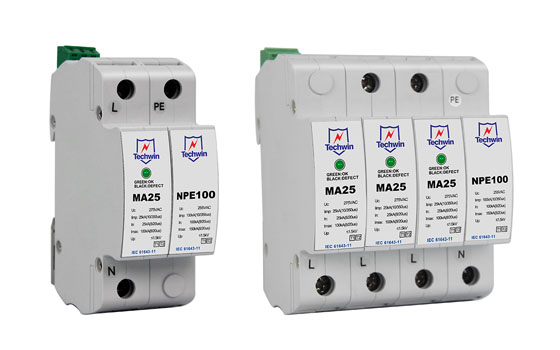
In residential, commercial, and industrial scenarios, ac spd is an important electronic device for protecting the safety of power lines and equipment. According to IEC (International Electrotechnical Commission) zoned lightning and multi-stage protection theory, power surge protectors can be divided into three levels: B, , C, and , D. If we observe closely, we will find that regardless of the level of the power surge protector, basic parameters such as Imax (maximum discharge current), In (nominal discharge current), Up (voltage protection level), and Uc (maximum continuous operating voltage) are indicated on it.
Uc, that is, the maximum continuous operating voltage, is the maximum effective value or DC voltage that is allowed to be continuously applied to the lightning arrester. Uc is crucial for surge protectors, especially for metal oxide varistor arresters. Exceeding Uc will lead to overheating, accelerated aging, or even damage to the surge protector. Therefore, the rated voltage of the surge protector should be greater than the nominal voltage of the grid connected to the lightning arrester.
In TT systems, when surge protectors are installed between phase-to-earth and neutral-to-earth, Uc should not be less than 1.55U0 (where U0 is the nominal voltage between the phase and neutral, 220V), i.e., Uc≥341V; when installed between phase-to-neutral and neutral-to-earth, Uc should not be less than 1.15U0, i.e., Uc≥253V. In TN systems, Uc should not be less than 1.15U0, i.e., Uc≥253V; in IT systems, Uc should not be less than 1.15U (where U is the line voltage, 380V), i.e., Uc≥437V.
From this, it can be seen that the selection of surge protector Uc is not the higher, the better. Choosing too high a Uc will result in the surge protector failing to start protection actions and not being able to effectively discharge surge currents. Therefore, when selecting the Uc value of the surge protector, it is necessary to fully understand the nominal operating voltage of the power supply system, the possible transient over-voltage conditions of the power system, and take into account the voltage resistance characteristics of electrical equipment.
Up, that is, the voltage protection level, for voltage switch-type surge protectors, Up is its maximum discharge voltage; for clamping-type surge protectors, when discharge current flows through the SPD, the peak voltage that appears across its terminals is called residual voltage. The maximum residual voltage value measured at the terminals of the lightning arrester using specified waveform and amplitude impact tests is called the measured limiting voltage. Up is used to characterize the limiting voltage parameter between the terminals of the lightning arrester, and this value should be greater than the highest measured limiting voltage.
When selecting lightning arresters at all levels, Up is an important index. If the Up of the first level lightning arrester plus the inductive voltage of its two ends and the reflection wave effect are not enough to protect the protected equipment at a distance, a power surge protector should also be installed at the protected equipment. When there is a distribution box between the installed first level and the last level surge protector, if the Up of the first level arrester plus the inductive voltage of its two ends cannot protect the equipment in the distribution box, then a second level lightning arrester should be installed in the box. The setting and selection of subsequent surge protectors mainly depend on their Up.
Equipment at the power supply location: Ⅳ class, Uw = 6kV
Equipment on power distribution lines and last branch lines: Ⅲ class, Uw = 4kV
Electrical equipment: Ⅱ class, Uw = 2.5kV
Special equipment requiring protection: Ⅰ class, Uw = 1.5kV
When we select the Up of the surge protector, usually Up≤0.8*Uw, leaving a 20% margin to ensure effective equipment protection. Of course, for most SPDs, Uc and Up mainly depend on the components selected, while discharge capacity not only depends on the components but also involves every part of the SPD being able to withstand the discharge current.
Choosing the right AC power surge protector (SPD) is crucial for protecting power systems and equipment. Understanding the meanings of Uc and Up and how to select them allows for better selection of suitable lightning arresters for different scenarios, ensuring stable system operation. If you have any needs or questions regarding AC power SPD, please feel free to contact us.
 Selection of Signal SPD Lightning Protection EquipmentMarch 13, 2023When it comes to the use of lightning arrester, many people lack a correct understanding of some of the parameters of the lightning arrester. Coupled with the increasing frequency of thunderstorms and...viewThe Difference Between Surge Protector and Air SwitchJuly 8, 2022Air switches and surge protectors are usually installed in the distribution box of a building, so what is the difference between them? Tiandun Thunderbolt will do a detailed analysis for you.Ⅰ. Surge...viewInstallation Steps of The Surge Protection DeviceAugust 30, 2021Ⅰ. Tools of installing a surge protection deviceBefore installing the surge protection device, tools such as a flat-blade screwdriver, a pair of wire strippers, some pliers and electrical tape are ne...viewLightning Protector: Essential Installation and Maintenance TipsFebruary 29, 2024As unpredictable as weather can be, one thing we can always count on is the presence of lightning during thunderstorms. While its awe-inspiring beauty can be captivating, the power of lightning can al...viewWhat is A Surge protective device(SPD)? How to install it in an AC power system?April 16, 2025A Surge Protective Device (SPD) is a critical component designed to safeguard electrical systems and equipment from voltage surges caused by lightning strikes, power grid fluctuations, or switching tr...viewPrinciples and Performance Parameters Determination, as well as Installation Regulations of Surge ProtectorsMarch 13, 2023Surge protection device, also known as SPD, is an electronic device that offers safe protection for various electronic equipment, instruments, and communication lines. It is used to limit transient ov...view
 EN
EN
 jp
jp  ko
ko  fr
fr  de
de  es
es  it
it  ru
ru  pt
pt  ar
ar  vi
vi  th
th  ro
ro  bg
bg  nl
nl