
This is the most effective and fundamental direct lightning protection measure, particularly suitable for lightning-prone areas or critical lines.
Principle: One or two well-grounded metal wires (typically galvanized steel strands) are installed atop utility poles above the power lines. During lightning discharge, the ground wire acts as the preferred point of strike, channeling the massive lightning current into the ground through the grounding device, thereby protecting the conductors below from direct lightning hits.
Applicable Scenarios:
Regions with frequent lightning activity (high average annual thunderstorm days).
Lines supplying critical loads requiring high reliability.
Lines passing through hilly or elevated terrain with high soil resistivity.
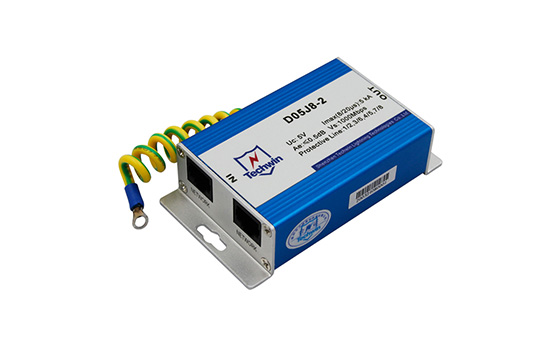
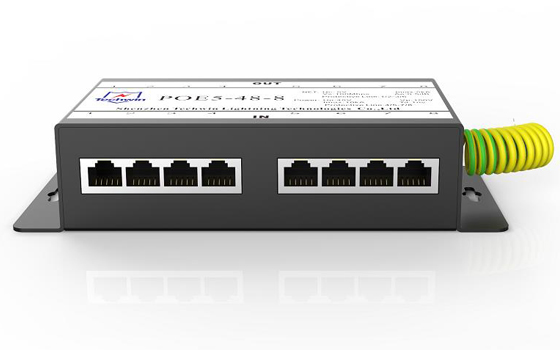
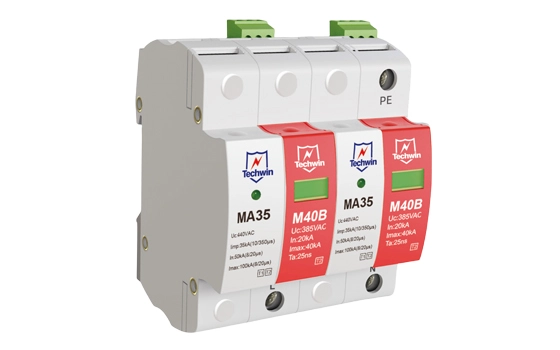
SPDs are primarily used to limit lightning-induced overvoltages. They serve as a crucial supplement to ground wires and are the main protection method for lines without ground wires.
Principle: SPDs are connected in parallel between the line (phase conductor) and the ground. Under normal operation, they exhibit high impedance and do not affect the system. When a dangerous lightning overvoltage occurs on the line, their impedance rapidly decreases to a low value, instantly diverting the lightning current and limiting the residual voltage to a level tolerable by equipment. This protects line insulators and electrical devices. Afterward, they quickly return to a high-impedance state.
Installation Locations:
Line endpoints: at the substation outlet and the end of the line (before entering user premises).
Critical poles such as branch poles, terminal poles, and angle poles.
Intermediate sections of long lines, installed at regular intervals (e.g., every 200–500 meters).
Entrances to particularly critical users or equipment.
The effectiveness of all lightning protection measures relies on proper grounding. Without adequate grounding, neither ground wires nor surge arresters can function effectively.
Requirements:
The grounding resistance of poles should be as low as possible (typically ≤30Ω, which may be relaxed to ≤50Ω in areas with high soil resistivity).
Grounding down conductors for ground wires and surge arresters must have reliable connections and sufficientcross-sectional area.
Grounding electrodes should be buried in moist soil. If necessary, soil replacement, use of resistance-reducing agents, or increasing the number of grounding electrodes can be employed to lower grounding resistance.
This is an economical and practical method but has certain limitations.
Principle: If structures such as buildings or trees taller than the line exist nearby and their protective zone covers the line, these natural objects can provide a degree of protection.
Note: This method is unreliable, as trees may be cut down, and their high resistance may cause side flashes during lightning strikes, endangering the line. It should not be relied upon as a primary measure.
1. Installation of Arcing Gaps: In some cases, small arcing gaps can be installed in parallel with insulators. During overvoltage events, the gap breaks down first, protecting the insulator from flashover. However, this may cause line tripping and requires coordination with auto-reclosing devices.
2. Use of Porcelain Cross-Arms or Enhanced Insulation: While not preventing direct lightning strikes, this improves the line’s withstand capability, reduces the probability of power arc formation, and lowers the risk of tripping.
3. Operation and Maintenance: Regular inspections to ensure ground wires, surge arresters, and grounding down conductors are well-connected, free from corrosion, and undamaged; periodic measurement of grounding resistance to ensure compliance with requirements.
For direct lightning protection of low-voltage overhead lines, a combined approach is typically adopted:
For critical lines in lightning-intensive areas: Prioritize the "ground wire + robust grounding" method, supplemented with surge arresters at key points.
For general lines: The most economical and practical solution is "multi-point installation of surge arresters + ensuring proper grounding for every pole."
In all cases: Adequate grounding is the cornerstone of all lightning protection measures and must be given high priority.
 Why Should Lightning Protection Systems Be Grounded?October 25, 2021We assume most people have a basic understanding of lighting protection system grounding, however, you may not be clear about why we have to use the lightning protection system grounding in the lighti...viewA Lightning Surge Protection Plan Required for Petrochemical ProjectsNovember 28, 2023Implementing a lightning surge protection plan is crucial for petrochemical projects to safeguard critical infrastructure, equipment, and personnel. Lightning poses a significant risk to facilities, e...viewWhat Is a Transient Voltage Surge Suppressor (TVSS)?June 26, 2024Transient Voltage Surge Suppressor (TVSS) is a device used to protect electronic equipment from transient overvoltage, spikes, or surges. With the increasing reliance on network infrastructure due to ...view90% of Projects Get Lightning Protection Wrong – This Critical Step Is Often OverlookedMay 16, 2026During the final acceptance inspection of many electrical projects, we often see a puzzling situation: “Everything seems to be done, but the system remains unstable.”Equipment is installed, surge pr...viewWhat Are the Lightning Protection Devices?September 18, 2021The whole set of lightning protection devices can be divided into flash catcher, lead wire, lightning protection and grounding device. Lightning protection device is to prevent the equipment from bein...viewWhat Are the Lightning Protection Systems Included in the Security Industry?March 13, 2023To know what lightning protection systems are available in the security industry, we must first understand the development and changes of the security industry. From the emphasis on "no AI, no se...view
 EN
EN
 jp
jp  ko
ko  fr
fr  de
de  es
es  it
it  ru
ru  pt
pt  ar
ar  vi
vi  th
th  ro
ro  bg
bg  nl
nl